Photo from US National Archives by Flip Schulke / Flickr
Lovely story on the always lovely “The Morning News” today about the dangers of camping – specifically, the dangers of camping in Yellowstone as a teenager getting ready for college with a film canister full of pot.
“Bears up there,” the Ranger said, glancing at our backcountry travel permit before tipping his broad-billed hat and ushering us out of his cramped station.
He didn’t caution us, or quiz us, or check our gear, or show us a pictogram of a car-sized beast licking brains from a pulverized human skull—and I can’t guarantee that even those warnings would have kept us from our 10-day hiking trip through Yellowstone National Park during what I’ve only recently learned was the peak of grizzly bear season.
We were just out of high school. We were constantly stoned. We traveled in an ode to that particular brand of privileged American adventure, the cross-country drive, funded in equal parts by savings from crappy after-school jobs at a camping store and graduation money from loving parents. In the fall, we’d both start at fancy colleges: Tim to Stanford, on his way to a pair of dad jeans and the hedge fund life in Silicon Valley, and me, to Vassar and non-profits and Brooklyn and waxing sentimental about stuff I did 15 years ago.
The term “Gonzo journalism” gets thrown around a lot to describe any journalist who writes a piece under the influence of drugs (or, at least, when he admits to this drug use in the story – otherwise I think a lot more journalism could be classified as “Gonzo”). But the movement that Hunter Thompson defined really had less to do with the use of drugs and kee-razy antics than it had to do with inserting yourself in the story, shedding any guise of objectivity, and reporting not just on the story but the reporting of the story as well. Take Fear and Loathing on the Campaign Trail as an example; while Thompson mentions Wild Turkey more times than you have fingers to count, the story is really about a reporter for the then-little-known Rolling Stone magazine pulling back the curtain on the ludicrous, staged, scratch-each-others’-backs nature of political campaign reporting.
I love this piece by Grant Howitt about the Panasonic Toughpad Press Conference because, while he does mention what he can piece together about the Toughpad, he casts a more inquisitive eye on the tech release press conference beast itself, and on the journalists at the press conference doing the reporting.
The devices can be used in heavy rainfall. I think for a second that the image illustrating heavy rain – a faceless man in a trenchcoat and leather gloves – looks like it is illustrating cold-war era spying, instead. The Toughbook would be good for spies, I think. It probably deflects bullets. You could use it to beat up an informant. That sort of thing. That should be their marketing gambit. An embittered agent thrashing the Toughbook against the face of a scared Eastern-European man, teeth and blood on the floor, yelling TELL ME WHERE THE BOMBS ARE HIDDEN DAMNIT TELL ME NOW PEOPLE ARE GOING TO DIE
Jan stops for a second and says there will be a demonstration. He says “With the nice police ladies we are to make some watersports,” and half-laughs, half-smiles awkwardly. He says that onstage in front of the world’s press. He seems to think that is fine. The women come forward and pour water from a jug over a toughbook sat in a perspex case. People take pictures.
A man in charge of something important just made a SEX PISS JOKE at the Panasonic Press Conference and that’s all fine. I don’t understand. I don’t understand. Is that fine? Is this just what happens at tech events? I want to have a lie down.
Since these press conferences are really little more than big commercials with the press releases already written, Howitt’s Gonzo approach seems to be a much better way into the story of our obsession with the latest and greatest tech.
Working in advertising, I sign up for a wide array of competitor emails to keep an eye on trends, interesting strategies and clever ideas. A lot of these emails slip right by me (I can rack up close to 200 in a week if I forget to clear my inbox) but sometimes they’ll catch my attention – and some, like this one from eyeglasses retailer Warby Parker, I just have to share.
Warby Parker is a boutique eyewear retailer that offers stylish eyeglasses at just $95 a pop. It sounds like there might not be a lot to that story, but Warby Parker really differentiates itself with a strong, fun brand. The copy on their site is clever, the photography is clean and interesting, the design is sleek and simple, and their social media presence is very strong.
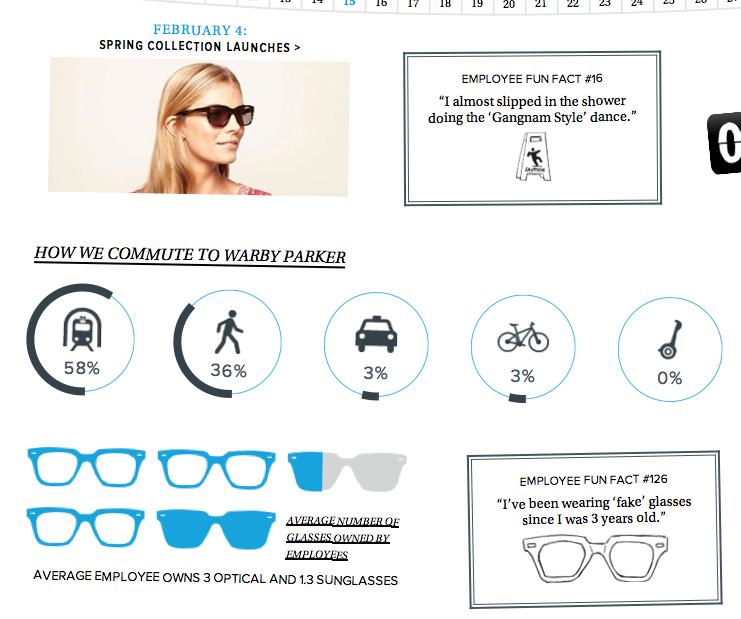
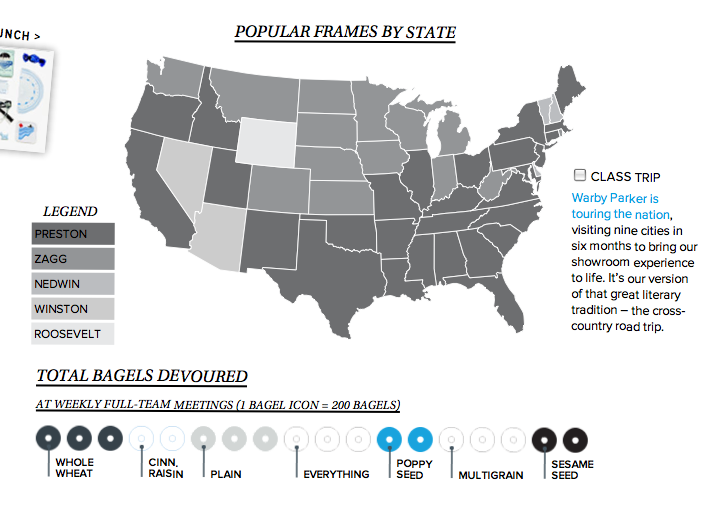
The email I got yesterday caught my eye because it doesn’t do any selling – it just directs customers to this interactive “Annual Report,” which tells the story of Warby Parker’s year through data like:
Average number of false fire alarms per week (2)
Office lunches by the pound
Number of monocles sold (296)
Total bagels devoured at weekly full-team meetings
I’m posted a few more shots below showcasing the great design and graphics that illustrate the report, but do yourself a favor and read the whole thing. Maybe it will even make you want to buy some glasses.
Photo: February 1986 cover of GQ / coverbrowser.com
Woody Allen has a piece about hypochondria vs. regular old alarmism in the Sunday Times, which has served the dual purpose of making me feel better about my own neuroses and making me realize it’s been far too long since I read Without Feathers.
But what’s this obsession with personal vulnerability? When I panic over symptoms that require no more than an aspirin or a little calamine lotion, what is it I’m really frightened of? My best guess is dying. I have always had an animal fear of death, a fate I rank second only to having to sit through a rock concert. My wife tries to be consoling about mortality and assures me that death is a natural part of life, and that we all die sooner or later. Oddly this news, whispered into my ear at 3 a.m., causes me to leap screaming from the bed, snap on every light in the house and play my recording of “The Stars and Stripes Forever” at top volume till the sun comes up.
Simon Rich reads from “Center of the Universe,” which
will appear in his new book The Last Girlfriend on Earth
I racked up a lot of my early writing clips in college writing humor pieces for websites like Yankee Pot Roast, Points in Case and CollegeHumor. I just recently started actively writing humor again, so I was delighted when I received an issue of The New Yorker last month that featured a story from Simon Rich titled “I Love Girl.” Back then, when I was writing and pitching humor pieces daily, I picked up Rich’s first book Ant Farm at the college bookstore. It’s a book I still flip through regularly, along with Jon Stewart’s Naked Pictures of Famous People, Steve Martin’s Pure Drivel and McSweeney’s Created in Darkness by Troubled Americans, whenever I need inspiration or just a good laugh. There seems to be a trend among comedians towards publishing more memoirs and confessionals, but I’m still a fan of the short humor collection above all else.
“I Love Girl” is the story of a caveman who is in love with a girl:
I have been working on Girl’s path for many years, picking up the black rocks and carrying them away. I never throw her rocks off the cliff like normal rocks. Instead, I put them in a pile next to my cave. I like to look at the pile, because it reminds me of how I am helping Girl. My mother, who I live with, says the pile “has to go.” (I worry that she will move the pile, but it is unlikely. After all, she is an elderly thirty-two-year-old woman.)
Somebody sent an article from Fast Company’s co.create blog around the copy department last week, and I saw that one of their writers, Joe Berkowitz, had recently conducted an interview with Rich. He offers some great insight into his process and how he jumps between different genres and forms (Rich has written for Pixar and SNL). I found this tidbit about generating ideas particularly inspiring:
I find in general that if I don’t have any ideas on what to write about, I just research whatever at the moment I’m extremely interested in. I read a lot of nonfiction on subjects I’m interested in, and that usually knocks something loose. A few months ago, I was stuck and I wasn’t really sure which of my projects to work on, and I was kind of bored with some of the stuff I was doing, so I just spent a few days reading books about monkeys and sign language and teaching them how to talk. Nothing came of it really, but by the time I was finished reading about monkeys, I was ready to jump back into my novel. Reading a lot of nonfiction helps. Wikipedia is also a big help. There’s always something interesting on Wikipedia–the random article button is great. When I was writing Free Range Chickens, I had just discovered Wikipedia and one of the ways I came up with ideas was to just keep refreshing, and keep clicking the random article until a premise occurred to me.
Photo: “Skiing and snowfields, c. 1930s,” by Sam Hood / Flickr
This piece by Jesse Singal utilizes one of my favorite writing tools for breaking into a story in a different way: taking a known form (in this case, a step-by-step guide) and using it to tell a story. Singal executes it perfectly, and as a neurotic myself, whose brain is “a machine built primarily to weave disaster movies out of life,” it hits home particularly well. Though I learned to ski at a young age, before I was aware of all the terrible things that could possibly happen that I might want to be afraid of, Singal’s observations about the finer points of skiing still strike all the right chords:
The sign by the lodge promises Refreshments. But for the mountain’s owners to display photos of thick hot creamy broth laden with clam and potato to very hungry, very cold people who have already paid an eye-bulging amount for the privilege of skiing, and to then attempt to charge them $9 for a thimbleful of it, isn’t just a ripoff—it’s a betrayal.
[A note about the photo – I found this great archival picture in the Flickr Commons, where a search for skiing brings up hundreds of funny, breathtaking and otherwise extraordinary shots, mostly of the vintage variety. Here are a few other shots from the collections – there are plenty on Flickr to check out if you’re interested.]
For the 15th anniversary of the release of Good Will Hunting, Janelle Nanos has compiled an oral history detailing just how the movie got made. Some great stories from everyone involved, including a lot of things that you don’t expect to hear in interviews with A-List Celebrities:
Damon: At that point Castle Rock was having us do these rewrites and we were going in circles.
Affleck: We were so frustrated that Castle Rock wasn’t reading the script, so we felt like we had to develop this test. We started writing in screen direction like, “Sean talks to Will and unloads his conscience.” And then: “Will takes a moment and then gives Sean a soulful look and leans in and starts blowing him.”
Damon: They weren’t reading the script closely anymore. It was literally probably a full paragraph about what these two characters were doing to each other.
Affleck: We would turn that in, and they wouldn’t ever mention all those scenes where Sean and Will were jerking each other off.
My girlfriend and I went to the White Mountains today for a quick hike and a chance to enjoy all the scenery bathed in fresh snow. Conway, North Conway and the Kancamagus Highway are all just a little more than an hour from Portland, and I find myself returning there more and more. The White Mountains were a staple of summer vacations in my childhood, but I was always more interested in helping Kirby save the world from King Dedede on my Game Boy than I was in being awestruck by the region’s natural beauty. Now there is little I enjoy more in life than getting outside and unplugging for a few days, hours, or even just my lunch break.
On the way back to Portland I queued up the latest episode of PRI’s Living on Earth on my iPod. Living on Earth held a regular place in my earbuds when I was working in a warehouse years ago, a reliable source for an hour of entertaining and informative listening while I moved Box A from Point B to Point C. LoE was absent from MPBN for the last few years, but it’s just recently returned to the lineup, which inspired me to download an episode.
Coming back to reality from my quick mountain getaway, this story in particular piqued my interest. In “The Changing of the Environmental Guard,” host Steve Curwood speaks with Gene Karpinski, President of the League of Conservation Voters, about what could happen to the country’s environmental policies this year with a new Congress and a re-elected President Barack Obama. After an election where environmental issues got barely any mention at all, and the House still looks largely the same, things still look king of grim. After a day like today outdoors in the White Mountains, I hope they get a lot better.
Photo: Dan Aykroyd and John Belushi as the Blues Brothers, Annie Leibovitz, 1979 (VanityFair.com)
Fascinating story in this month’s Vanity Fair about the making of The Blues Brothers — a movie that barely got made and seemed guaranteed to lose truckloads of money.
Everything revolves around Belushi, the most electric and popular comic actor of his time. It would be inaccurate to blame all the movie’s problems on Belushi. He isn’t responsible for the late-developing script or the unwieldy action sequences. It would be even more inaccurate to say Belushi isn’t responsible. He has become a blessed wreck, thanks mostly to his spiraling (and ultimately lethal) addiction to cocaine.
On days when coke gets the best of Belushi, production stalls. And when production stalls, money burns.
Photo: Zastol`skiy Victor Leonidovich/Shutterstock (from OutsideOnline.com)
Today, for all my fellow New Englanders battling close-to-zero temperatures: a fascinating story from Outside Magazine about how freezing to death works.
It was a mistake, you realize, to come out on a night this cold. You should turn back. Fishing into the front pocket of your shell parka, you fumble out the map. You consulted it to get here; it should be able to guide you back to the warm car. It doesn’t occur to you in your increasingly clouded and panicky mental state that you could simply follow your tracks down the way you came.




 Jake Christie